
ここから本文です
TWO:

Hydrocyclone (liquid cyclone)01

Hydrocyclone (liquid cyclone)02

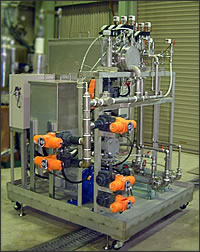
A hydrocyclone (liquid cyclone) injects treatment solution into stationary equipment to perform separation, classification, and concentration, and is an innovative separator with a very simple structure and no drive unit.

Structure of a hydrocyclone (liquid cyclone)

A suspension containing fine particles of several micrometers or more is supplied to a cylindrical container circumferentially at high speed. And as a result it starts to rotate and a centrifugal force is generated. At this time a gravitational acceleration of several tens of thousands of G is generated in the circumferential direction, and thus leading to fast sedimentation and concentration of the fine particles. The separated concentration can be freely selected by changing the supply rate (supply pressure and flow rate) and the flow ratio of the outlet. Our hydrocyclone (liquid cyclone) was designed and manufactured to classify and concentrate fine particles, and so has a small element.

THREE: We are still anxious to know whether our perception of a real world comes to us by an exercise of thought, or by a simple impression of sensewhether it is the universal that gives the individual reality, or the individual that shapes itself, by some process not explained, into a universalwhether bodily movements are the causal antecedents of mental functions, or mind rather the reality which gives truth to bodywhether the highest life is a life of thought or a life of actionwhether intellectual also involves moral progresswhether the state is a mere combination for the preservation of goods and property, or a moral organism developing the idea of right. And about these and such like questions Aristotle has still much to tell us.... His theory of a creative reason, fragmentary as that theory is left, is the answer to all materialistic theories of the universe. To Aristotle, as to a subtle Scottish preacher [Principal Caird] the real pre-supposition of all knowledge, or the thought which is the prius of all things, is not the individuals consciousness of himself as individual, but a thought or self-consciousness which is beyond all individual selves, which is the unity of all individual selves and their objects, of all thinkers and all objects of all thought.167The old age of Plato seems to have been marked by restless activity in more directions than one. He began various works which were never finished, and projected others which were never begun. He became possessed by a devouring zeal for social reform. It seemed to him that nothing was wanting but an enlightened despot to make his ideal State a reality. According to one story, he fancied that such an instrument might be found in the younger Dionysius. If so, his expectations were speedily disappointed. As Hegel acutely observes, only a man of half measures will allow himself to be guided by another; and such a man would lack the energy needed to carry out Platos scheme.158 However this may be, the philosopher does not seem to have given up his idea that absolute monarchy was, after all, the government from which most good might be expected. A process of substitution which runs through his whole intellectual evolution was here exemplified for the last time. Just as in his ethical system knowledge, after having been regarded solely as the means for procuring an ulterior end, pleasure, subsequently became an end in itself; just as the interest in knowledge was superseded by a more absorbing interest in the dialectical machinery which was to facilitate its acquisition, and this again by the social re-organisation which was to make education a department of the State; so also the beneficent despotism originally invoked for the purpose of establishing an aristocracy on the new model, came at last to be regarded by Plato as itself the best form of government. Such, at least, seems to be the drift of a remarkable Dialogue called the Statesman, which we agree with Prof. Jowett in placing immediately before the Laws. Some have denied its authenticity, and others have placed it very early in the entire series of Platonic compositions. But it contains passages of269 such blended wit and eloquence that no other man could have written them; and passages so destitute of life that they could only have been written when his system had stiffened into mathematical pedantry and scholastic routine. Moreover, it seems distinctly to anticipate the scheme of detailed legislation which Plato spent his last years in elaborating. After covering with ridicule the notion that a truly competent ruler should ever be hampered by written enactments, the principal spokesman acknowledges that, in the absence of such a ruler, a definite and unalterable code offers the best guarantees for political stability.
  • Equipment costs can be reduced.
  • Operating costs can be reduced.
  • Maintenance costs can be reduced.
  • Any change in raw material and product can be easily addressed.
  • Large amounts can be treated in a small area.
  • Separation and cleaning are easy because of the simple structure.
  • Simplified control
  • This equipment can be operated in synchronization with external devices.
  • Alarm and interlock mechanism.
THREE:The man behind staggered back and muttered something that sounded like admiration. Ren Lalage stepped inside and shut the door.
  • Classification and concentration for the manufacture of inorganic powder materials
  • Classification of ceramic materials
  • Removal of fine particles, including iron powder
  • Removal of fine particles from pigments
  • Removal of fine organic particles from solvents
  • Separation of starch and yeast
  • Removal of fine particles from high-temperature strong acid solutions
  • Removal of fine particles from low-temperature solutions